Cashske
Payment automation for mobile-wallet cash — a transfer lands on a phone and the customer's order is credited seconds later, with nobody watching.
// By the numbers
- 3
- Codebases
- 5
- Product surfaces
- AR · EN
- Interface languages
- 2
- Auth layers
Node.js API, web dashboards, and a Flutter Android companion app
merchant dashboard, admin console, marketing site, mobile app, hosted confirmation flow
right-to-left Arabic across every merchant-facing surface
sessions for people, API keys for server-to-server merchant integrations
What the business was up against
A small Egyptian merchant selling online in 2023 had no good way to take money. Card gateways were expensive and gated behind KYC that a young business could not clear, so the practical alternative was the one their customers already used: mobile wallet transfers. That worked, but only manually. The transfer arrived as an SMS on somebody's phone, and a person had to read it, find the matching order, decide whether the amount was right, and credit the customer by hand. It did not scale past a few dozen orders a day, it ran only while someone was awake, and every step of it was a place to make a mistake. The payment rail existed and worked fine — what was missing was everything between the notification and the order.
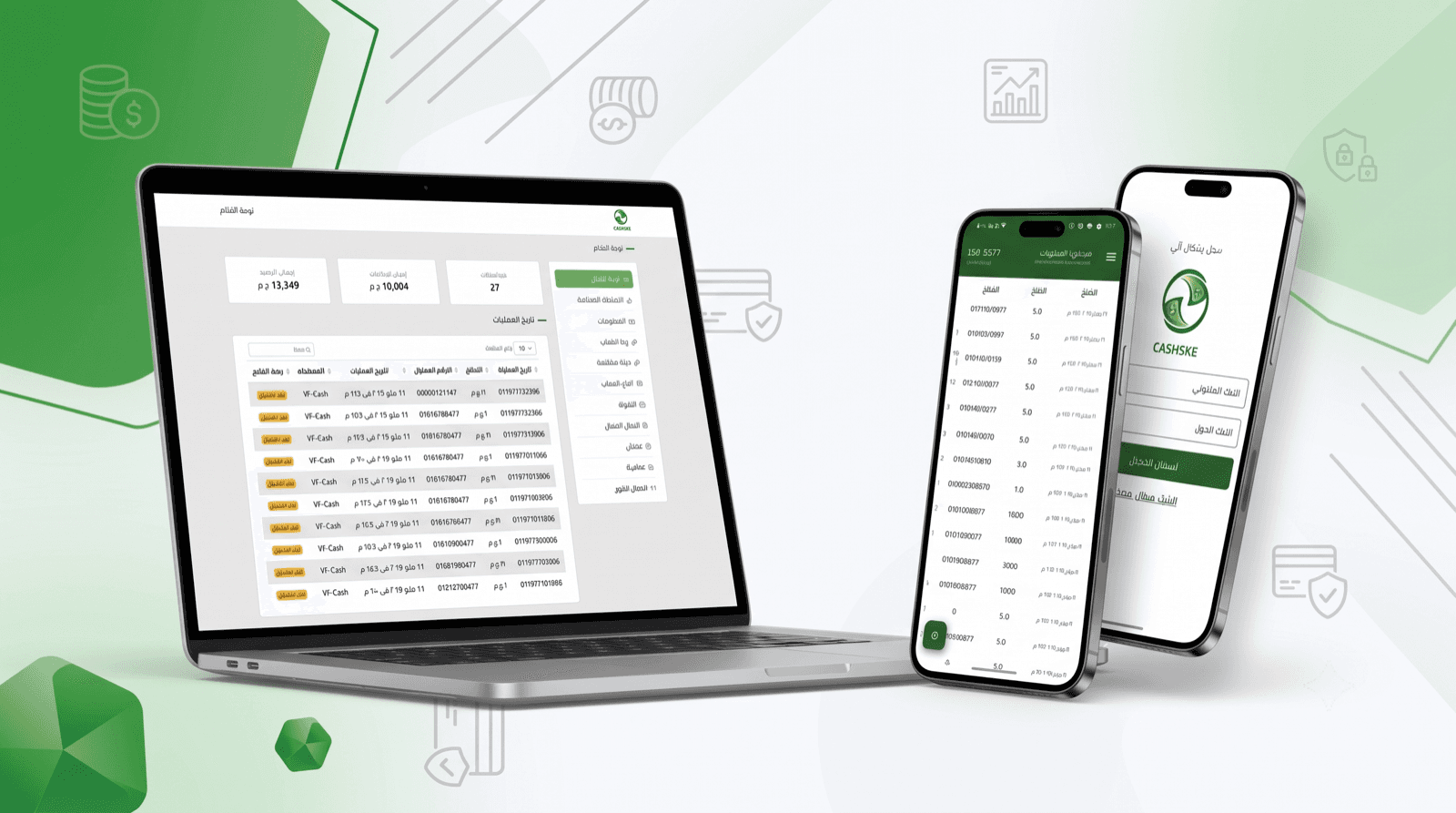
A payment-reconciliation platform for merchants who could not get a card gateway. Mobile wallets were already how their customers paid — the gap was that a wallet transfer landed as a text message on a phone, with no connection to the order waiting online. Cashske closed that gap: a companion Android app watched the receiving phone, a parser pulled the amount and sender out of the bilingual notification, and the backend matched it to an order and credited it in real time. Three codebases — a Node.js API, web dashboards for merchants and administrators, and the Flutter app that made the whole thing work.
How it's put together
Companion App
Flutter Android — watches the receiving phone
Notification Parser
Bilingual extraction of amount, sender, reference
Offline Queue
Hive-backed retry until delivery is confirmed
REST API
Merchants · transactions · payments · keys
Merchant Dashboard
Balance, history, configuration
Admin Console
Accounts, payments, abuse tooling
MongoDB
Merchants, transactions, balances, configuration
PerfectPanel
Credits the end customer in the merchant's panel
Kashier
Hosted checkout for balance top-ups
Transactional Email
Verification and account mail
The companion phone is the sensor; the API is the only thing that decides whether an order gets credited.
The calls that shaped it
The handful of decisions that determined how this system behaves — and what each one bought.
- 01
A bridge over an existing rail, not a new one
Becoming a payment processor means licensing, settlement and holding other people's money. Cashske deliberately did none of that — the wallet transfer goes directly from customer to merchant on the telecom's rail, and the platform only observes that it happened and tells the store. Reconciliation rather than processing is what made the product buildable by a small team, and it is the distinction the whole design follows from.
- 02
The receiving phone is the integration point
There was no API for incoming wallet transfers, so the only reliable signal was the notification the wallet itself sends. A companion Android app running on the phone that receives those messages became the sensor — an unglamorous integration, but the one that actually existed, and building against the real rail beat waiting for an official one.
- 03
Parse the notification bilingually, or parse nothing
Wallet notifications arrive in Arabic or English depending on the sender's handset and provider, with the amount, sender and reference formatted differently in each. The parser had to handle both to be useful at all, so bilingual extraction was a requirement of the core loop rather than a localisation task layered on afterwards.
- 04
Assume the phone will lose connectivity
The sensor is a consumer handset on a mobile network, so dropped connections are the normal case, not the failure case. Confirmed transfers queue locally in Hive and drain when the network returns, and a periodic sweep re-checks for messages that arrived while the service was down — because a payment that is detected but never delivered is indistinguishable, to the customer, from one that was never detected.
- 05
Meet merchants inside the software they already sell from
Most target merchants ran PerfectPanel, so the platform integrates with it natively and credits the end customer's balance there directly — no glue code on the merchant's side. A REST API with its own key-based auth covers everyone running something custom. Integrating into the incumbent tool is what made adoption a configuration step instead of a development project.
- 06
Prepaid fees, so the platform never holds merchant money
Merchants top up a balance and a configurable per-transaction fee is deducted from it as payments reconcile, with card top-ups handled through a hosted Kashier checkout. Keeping the platform's revenue entirely separate from the payment flow meant customer money never sat in an account Cashske controlled.
- 07
Where the next version would have gone
A later design review identified the parts that needed hardening before scale: a double-entry ledger with atomic balance mutation, reference-code verification so a transfer is matched rather than inferred from an amount, signed webhooks for merchant callbacks, and migration onto official wallet rails as they opened up. That work was specified but not built — the company wound down first. Naming it is more useful than pretending the first iteration was the finished one.
Signature capabilities
Automatic transfer detection
A companion app on the phone receiving wallet notifications reports confirmed transfers to the backend as they arrive, replacing a person reading messages and crediting orders by hand.
Bilingual notification parsing
Amount, sender and reference are extracted from wallet notifications written in either Arabic or English, formatted differently by each provider — the core loop of the product.
Delivery that survives a dropped connection
Confirmed transfers queue on the device and drain when the network returns, with a periodic sweep catching anything that arrived while the service was down.
Native PerfectPanel crediting
For merchants on PerfectPanel, the end customer's balance is credited directly in their own panel, making adoption a configuration step rather than an integration project.
REST API for custom stores
Merchants running their own storefront integrate over a documented API with its own key-based authentication, separate from the dashboard's user sessions.
Administrative and abuse tooling
A role-based console for accounts, transactions and payments, including shared-address analysis across accounts, blocking, manual balance adjustment and a global configuration system.
Business feature set
The functional scope delivered across every part of the product.
Payment reconciliation
- Automatic detection of incoming wallet transfers
- Bilingual Arabic and English notification parsing
- Real-time crediting of the matching order
- Periodic reconciliation sweep for missed notifications
- Transaction history with search
Merchant dashboard
- Balance and transaction overview
- Top-up by card or wallet transfer
- API key management
- PerfectPanel, domain and currency configuration
- Device management for companion phones
- Usage analytics and charts
Companion app
- Background service on the receiving phone
- Offline retry queue with guaranteed delivery
- Live balance and searchable history
- Device registration and management
- Right-to-left Arabic interface
Administration
- Account and merchant management
- Payment and top-up oversight
- Shared-address analysis and blocking
- Manual balance adjustment
- Role-based administrator accounts
- Global configuration and messaging
What changed operationally
Documented outcomes from the delivered system. Where exact figures are confidential, the operational change is stated instead.
- Manual payment checking replaced by automatic detection and crediting
- Merchants without card-gateway access able to take online payments on the rail their customers already used
- Real-time crediting into PerfectPanel, or into a custom store over a REST API
- Offline-tolerant delivery from the companion app, with a reconciliation sweep for missed notifications
- Prepaid per-transaction fee model with card top-ups through a hosted checkout
- Administrative console with account, transaction and abuse-management tooling
- Three codebases and five product surfaces delivered and operated together
- Right-to-left Arabic across every merchant-facing surface
What we had to work within
- No official API for incoming wallet transfers — the notification was the only available signal
- The sensor is a consumer Android phone on a mobile network, so connectivity is unreliable by default
- Wallet notifications arrive in Arabic or English, formatted differently by provider
- Target merchants could not clear card-gateway KYC — that exclusion was the reason the product existed
- Merchants ran an existing panel product, so integration had to be configuration, not development
- Small team across backend, web and mobile simultaneously
What I owned
End-to-end on this project — from architecture and data modelling through to a shipped, production product.
- Node.js and Express API across merchants, transactions, payments and keys
- Notification parsing engine and the reconciliation loop
- Flutter Android companion app with background service and offline queue
- Merchant dashboard and administrative console
- PerfectPanel and Kashier integrations
- Marketing site and hosted transfer-confirmation flow
Built with
Backend
Data
Mobile
Web
Integrations
Want something like Cashske?
Boutique software studio — agency-quality systems, shipped by one senior engineer.
// Related work